|
|
|---|


Well, now.
I have a new Heroclix map or two to share with you, and I have to finish up Supergirl versus the Gang, and I need to get current with the Shield's adventures---
but given DC's announcement this week of a universal reboot in September, those will all have to wait a bit. Apparently a REAL universal reboot, not just a 'housecleaning'.
For good or for ill, this is astonishing. As discussed in my previous post, nothing of this sort has really been done before (despite what anyone tells you). This is, potentially, the biggest deal in all of of DC's history, other than the Golden Age itself.
Whatever else, it is an enormous opportunity. In fact, I can think of, oh, let's say, 52 things, large and small, that this is the opportunity to fix:
- A Penguin who's not a punching bag.
- We can all be mind-wiped of Identity Crisis. Tegrof!
- Lex Luthor will no longer have been president.
- Removing NYC from the DCU. Because really... it's just in the way.
- The 'generation creep' that's caused a temporal pile-up of aging teen sidekicks bumping up against un-aging icons can go away.
- Pa Kent. Because, well, he's a better character alive than dead, basically.
- The Death of Aqua-baby -- the crack in the ice that led to our recent decades of darkness, death, and damage -- can be avoided.
- Jean Loring. Period.
- Detaching the JSA from WWII, which is the current ruination of a sliding timeline. They didn't actually fight in WWII, you know, despite what many of you think. They fought saboteurs and profiteers on the homefront; sometimes I wonder whether any of you have actually read a Golden Age JSA story!
- Martian Manhunter as a actual detective in Apex City. Oh, yes; embrace it now.
- Marv Wolfman's Teen Titans -- the crack in the ice that led to our recent decade of faux-Marvel whining, talky-talking, and adolescent drama. Avoiding that alone is worth a universal reboot.
- You want ADULT drama, instead? Golden Age Starman, folks. Golden Age Starman.
- Clayface as the mad movie actor he originally was, not a Marvel-style monster-villain with sci-fi powers.
- No more earth-based GLs other than Hal Jordan.
- Replace Washington DC with Federal City again, and make it Wonder Woman's fictionopolis. That will go a long way to putting her back on track.
- Making the Chief a good guy again.
- No more "Deathstroke the Terminator". Really, just do not go there at all.
- A JLA origin that doesn't involved the Appellaxians. Because, classic though it is, that story is really really stupid.
- An actual purpose for Wonder Woman.
- A version of Gotham City that doesn't make you wonder, "Why the heck does anyone live there?"
- Jimmy Olsen as a well-intentioned but hapless young nerd with heroic pretensions that geeky younger readers can identify with. I mean, one without spider-powers.
- Green Arrow back to his Golden Age glory. Glory being a relevant term, of course.
- Barbara Gordon = Batgirl.
- The return of Sensation Comics.
- Maybe an actual gay superhero; I mean, one with name that people might actually recognize, not junk-drawer
- The Catwoman as an actual villain, not a 'cat-burglar with a heart of gold'. A villain in a dress, goshdarnit.
- Etta Candy, baby. Real Etta Candy, fat 'n' sassy.
- Villains like Killer Moth can be reintroduced without the baggage of years of continuity treating them as laughingstocks. Okay, really, there are no villains quite like Killer Moth; but you know what I mean.
- Kal'durh as the original Aqualad, without the embarrassment of the Silver Age big-headed, purple-eyed freak who preceded him.
- The Riddler as a gore-free-Jigsaw-style, Xanatos-gambitin', big-time player, rather than a joke.
- A whole revamp of J'onn J'onnz's powers to make him easier to use. Just give him a few powers unique in the JLA like shape-change, phasing, telekinesis, and the ability to create ice cream cones with his mind.
- A series for the Phantom Stranger. And perhaps another for just his hat.
- A renaissance of the some of the "lesser" fictionpolises, like Opal City, Calvin City, Midway City, etc.
- Non-addict Speedy.
- Lois and Clark not married. NOT because I don't like them married. But because there was no build up to it. There was no real development of a relationship between the two that made you believe Clark and Lois fell in love and would marry, just a rush to match the plot of the silly Lois & Clark television show.
- A re-telling of the Case of the Penny Plunderer, with Joe Coyne as an obviously deranged lunatic. "PENNIES WILL BE MY CRIME SYMBOL!"
- No Doomsday!
- The chance to give Green Arrow and Martian Manhunter actual rogues' galleries of their own that don't embarrass them. As long as there is still the Human Flame.
- Potentially, a clear break to begin a new Comic Book Era. The Gilded Age...? The Platinum Age?
- No more attempts to make the Fourth World live on when its creator, who should have been the only person to handle the characters, does not.
- "Montevideo of Uruguay: LIVE!"
- A Golden Age style, sane Joker. Pure malevolent wickedness that scares the crap out of you and swims really really well. Not an irrational gibbering mountebank. Yeah, you go ahead and fight me on this one.
- Aquaman as a/the leader of the JLA. It would help define who he is, a lot, and it's really not a role one of the Big Three should ever have.
- The opportunity to apply the Dynastic Centerpiece model with a little forethought and diversity, rather than having a supporting cast of archetypes simply crop up like inevitable mytho-structural dandelions.
- Returning Plastic Man to his original role as a straight man around whom wackiness occurs, rather than his current one as a consistently unfunny comedian.
- The opportunity to focus on creating new stand-alone stories rather than merely extending continuity.
- Vibe. Alive, breakdancing, and living large. Shut up, you know you want it, too.
this is the audience participation part.
What do you perceive as the top five opportunities in this Platinum age reboot that I've not listed?
So, I’m sure you aware of the MYSTERY shrouding the DCU after September when Flashpoint wraps up, and that some kind of ‘bombshell’ announcement is planned for early June.
Many theories have been posited, from the bland (“So and so will be the new creative time on Icon-man!”) through the hopeful (“DC will announce a JLA movie!”) and idiosyncratic (“Vibe will be the new Protector of the Earth!”) to the preposterous (“DC will stop publish monthly comics”).
Okay, I confess: the Vibe one was mine.
But consensus centers around the idea that the DCU will get a universal reboot. Much of the discussion consists primarily of reactionary eye-rolling (“DC is addicted to universal reboots!”)… and much of that is deserved. However, much of it also seems to miss an important point:
DC has never had a universal reboot.
Oh, it’s shut down some non-working programs with Task Manager, and cleaned out its cache a couple of times. But an actual reboot? Nope.
After Crisis of Infinite Earth and Zero Hour, there were a few changes to backstory (“The Kents are alive!” “Wonder Woman wears sweaters!”), but for the most part the whole DCU pretty much picked up in medias res and moved on. Except for Superman and Wonder Woman, we didn’t watch any characters “start over” again. And as for Infinite Crisis, well, the only thing that came of that was a run on CVS for aspirin to recover. Morrison succeeded to some degree, in that he convinced me that the Anti-Equation did exist; except it was titled Infinite Crisis, which convinced me that life was meaningless and sapped me of my will to think for myself; Morrison likes that.
The closest thing that DC has ever had to a universal reboot wasn’t really announced and was, well, a “soft reboot”: the Silver Age. “The Big Three” kept a thread of continuity—too much momentum there to waste—but everything else got restarted. Of course that was easy to do since… everything else had stopped. During the dark interregnum between the Golden and the Silver Age, virtually no superhero comics—the pillars of DC continuity—were being published, other than ‘the four superfriends’ (Superman, Batman, Wonder Woman, and Aquaman; and I guess Green Arrow, but we all know Green Arrow doesn’t count). DC created a whole new DCU, including a new Flash, a new Green Lantern, a new Hawkman, a new Atom, some freaky Martian, and a modernized “JSA” (now named the “JLA”) practically overnight.
And that was exciting! So was the reintroduction of Superman and Wonder Woman after COIE. I, the reader, was right there in on the ground floor for this ‘new’ but familiar character. They kept their iconic value—reclaimed it, really, by shedding years of accumulated literary dross—and began new adventures with fresh interpretations of their familiar foes and friends. Whether you liked all the decisions that were made in the process is beside the point; the approach was the right one.
Think of some of DC’s most exciting multimedia projects since COIE: Batman the Animated Series, the Justice League Unlimited, The Batman movies, the Teen Titans cartoon, Batman: Brave& the Bold. A huge part of the fun was… the starting over. Watching this new version of the DCU reveal itself and evolve bit by bit.
I’m hoping DC has the cajones to do a real universal reboot. They might pick up new readers; older ones like me will stick on; it’s the middling ones, the ones who can’t imagine a world without a “Nightwing”, who might bolt. But DC has got to do something to make their stories more accessible. Mainstream comics have long since given up on the principle that “every comic is someone’s first”; instead they cling desperately to the principle that “this comic must NOT be someone’s last!” This gives us an endless cascade of ‘can’t miss’ cliffhangers to keep dying addicts addicted, rather than an endless parade of new stories to keep new readers interested. That parade is EXACTLY why fans love most of the multi-media versions of the DCU: stories that are enriched by having knowledge of DC history, but not dependent on it.
Wouldn’t it be nice if DC were bold and brave enough to take that approach to their monthly comics? I think it’s time.
Heck… I’ve been waiting for it since 1986.
Make no mistake. I will not like everything that Geoff Johns does with Aquaman. But I am confident that he will do right in setting the character back on track. Why? Because the evidence is clear that Johns understands the three steps to re-establishing an iconic character.
1. Acceptance of the Essentials
Geoff Johns respects the essence of a character's myth. What is the essence of a character's myth? Isn't that act of deciding what a character's essence is subjective? Perhaps. But on the whole "essential" means the elements mostly commonly associated and accepted by the wider public as part of the hero's mythos-- not just the parts the writer happens to like.
The main point here is that Johns does not begin with the presumption that the character is essentially... stupid. He does not think, "Whoa, this character's basic story is ridiculous, and now it's totally broken." Why? Because, regardless of exactly how he terms it, he looks at the characters as mythic. And, as a serious student of mythology knows...
myths are always ridiculous.
Myths are full of trickster spider-gods and holy castrations that birth goddesses and people turning wine in water. A billionaire who beats up muggers as a hobby? Ridiculous. The world's most powerful being contents himself with living as a bullied milksop? Ridiculous. A princess created out of clay by an ancient immortal, magical, and scientifically advanced sisterhood and imbued with superpowers by Greek gods, who, coming to America to fight our enemies foreign and domestic and teach us that male aggression can only be tamed through submission to the happy controlling bondage of women's power of love, meets a lookalike war nurse with the same name as hers whom she can immediately pay to move to South America so she can assume her identity? Really, the word "ridiculous" simply does not cover it.
Geoff Johns does not shy away from the essential ridiculousness of the characters he tackles. He embraces it He accepts that the ridiculous essence of the myth is part of what makes it powerful, part of why the characters persists, long after more "realistic" characters have been forgotten and abandoned.
2. Incorporation of the variations
Well, where I was taught this concept we didn't call it "incorporation"; when talking about myths, we called it "syncretism". Regardless of what you call it, it's a step beyond just accepting the essential myth. It's accepting the value of the essential myth-- and all the variations of the myth that have arisen, even when they seem to be in conflict. Its highest expression is the attempt to reconcile the variations of a myth, into one larger, more powerful version of the myth.
Like it or not--or like how he does it or not-- this is exactly what Johns does. Sometimes there's a quite of hand-waving, even to the point of literary legerdemain. But generally, since the outcome is "mythically desirable" to the public, they happily suspend their disbelief of whatever means Johns uses to get them where they want to be.
3. Expansion of the mythos by extension or elaboration
Timid writers fear adding any new to a mythos, sometimes out of overwhelming respect for the character. This is particularly true for writers who started as fanboys. Brash writers contradict or at times throwout the existing mythos, trying to turn the character they've been given into a different one (e.g., Peter David on Supergirl). Respectful but bold writers keep older essential elements, but do not hesitate to add appropriate new ones (which we'll call expansion by extension) or extrapolate older elements into new directions and territory (which we'll call expansion by elaboration).
A simplified way of looking at it. is that the writer asks himself or herself:
- What are the top ten things "everyone knows" about this character and how can I best make them work together?
- How can I make the" other stuff" part of that and make it cool?
- Once that's done, how can I make the story bigger or deeper in way consistent with what I've put together?
A brief look at John's treatment of three classic characters, all of whom he brought back from utter extinction, shows his application of these principals.
For Hawkman, he focused on essential elements (Shayera as Hawkgirl and the relationship with her, the reincarnation and connection with ancient Egypt and history, the museum setting, the Thanagarian connection), incorporated variations and history (e.g., quickly merging the blond Golden Age Hawkman with the black-haired Silver Age Hawkman into the brown-haired modern Hawkman, putting all of Hawkman's rogues gallery back into play one by one, bringing back Golden Eagle), and expanded on the mythos (e.g., creating a new and unique fictionopolis for Hawkman to replace the vague and unessential Silver Age setting of Midway City).
For Flash, he re-established the essentials (Barry Allen the slow and methodical police scientist, his relationship with reporter Iris West, his friendships with Wally and Hal, Central City and its Rogues' Gallery, bringing Capt Boomerang back from the dead), incorporated variations (e.g., keeping the "speed force", the West-Park family, Max Mercury, and Jay Garrick, re-setting Bart Allen and making him Kid Flash), and elaborated on the mythos (e.g., making Barry the generator of the speed force rather than its recipient, creating co-worker characters for Barry, putting a new spin on the Reverse Flash's powers).
For Green Lantern, he stopped the "GL-of-the-decade" cycle by restoring the GL essentials (test pilot Hal Jordan, the importance of fearlesness/willpower, Carole Ferris, refurbishing the Lantern foes, revitalizing the Corps and the Guardians), incorporated variations (e.g. finding off-world roles for John Stewart, Guy Gardner, and Kyle Rayner) and elaborated on existing elements into new territory (e.g., taking the existence of a ring of a different color (yellow) and the association of "willpower" with the "green" lantern and extrapolating those into other color rings with their corps and own associated mental states).
Lest you think I'm just a Johns-nut, I have to confess I do not like all of the results of what Johns has done. The GL Corps bores me, the Flash's stories are still achingly slow, and Hawkman has still not found a stable place in the DCU. But there is no question that Johns has done the (apparently) impossible in getting these three characters (each of whom has been completely written off as toxic, irredeemable, and, well, dead) back on track.
Similarly, it's important to point out that Johns is not the only writer who takes this approach. Kurt Busiek and, of all people, Grant Morrison do as well. Taking this three-pronged approach to mythic revitalization doesn't mean doing it perfectly. Busiek did wonders with Superman in almost no time at all; however, his work on Aquaman was less successful because, I think, he mis-identified what the essential elements of Aquaman were. Morrison seems to take this approach (he masterfully boiled down Superman's origin and did essential characterization work on Jimmy Olsen and Lex Luthor in All Star Superman, and has steadfastly tried to incorporate outlying Silver Age and Bronze Age variations into the Batman mythos); he's just undone by his inability to weave it all into a coherent whole (or, for that matter, a coherent story, or even coherent sentences). If you take a look at other good writers working on revitalizing existing properties (such as Levitz on Legion), you'll be able to spot the approach.
How exactly will Johns apply this approach to Aquaman? He's already given us some clues, such as his revitalization of Mera (acceptance), the recasting of her homeworld as a other dimensional penal colony for former Atlanteans (incorporation) and creation of the new Aqualad (an extrapolation of the conflict between Aquaman and Black Manta). Time will tell how he will apply it further, but for now it appears that Aquaman is in good hands.
In previous posts, we introduced the concept of the “persona cycle” – the process of a character rotating back and forth between the extremes of one dimension of his personality. Having numerous layers of persona-cycles gives long-running characters (such as DC supeheroes and villains) the ability to be portrayed in a wide variety of ways, used in many different types of stories, and experience character development without ever becoming unrecognizable or falling “out of character”. We have already applied the theory to Superman and Batman. But as they say, “what’s good for the goose”, so now let’s take a grey-eyed gander at Wonder Woman and the dimensions of her persona-cycles.
First person to make a schoolboy comment about a woman having “cycles tee hee”, gets a three-day suspension.
Mythic/mundane
Wonder Woman’s origins are rooted in Greek mythology; unabashedly, irrevocably, and deeply. Sometimes writers embrace the Greek mythology wholeheartedly, with Olympians and their assistant as regular characters. Marston had Wonder Woman working against the machination of Ares in the 1940s, as did Perez in the 1980s. Sometimes genuine ancient myth is used as foundation for a broader mythos that is Wonder Woman’s alone, allowing for the creation of characters such as the Duke of Deception (1942 & 1975), Decay (1987), Devastation (1999).
But the draughts of myth are a heady brew! Maybe the Olympians can subsist on nothing but nectar and ambrosia, but we human readers often need more meat and potatoes in our literary diets. Fortunately, Wonder Woman can cycle toward the mundane just as easily as the mythic. Now, “mundane” in this context just means earthly, not boring or ordinary. Having a villain whose head is a domino strap you to an atomic missile and launch you from his battleship at New York City or fighting a giant Communist egg are in no way ordinary. But they are technically mundane, rather than mythic.
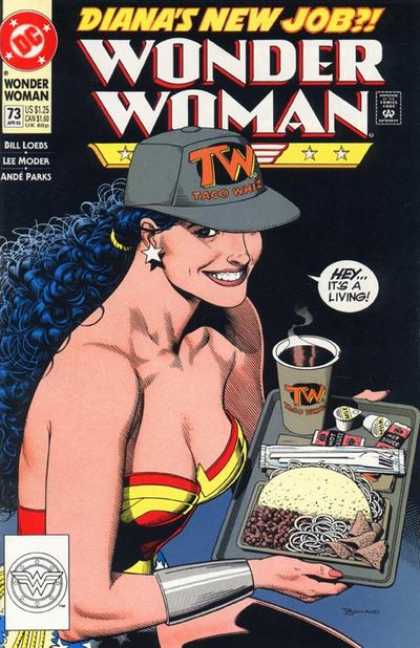
And, while Wonder Woman seldom finds herself beating up muggers in back alleys, her mythic origins are not so lofty that writers are afraid to get her hands dirty. Wonder Woman will run a dress shop, help department store worker get fair treatment, shoot at planes with an automatic rifle, save you from a lesbian sex slave ring, work at Taco Whiz, or take minutes at a JSA meeting. Wonder Woman is not about being too dignified to do anything but battle godlings, she’s about bringing dignity to everything you do. Particularly marching.
Superhero/secret agent
Similar, but distinct from the mythic/mundane cycle, is Wonder Woman’s Superhero/Secret Agent cycle. Sometimes, WW is yer standard superhero: fightin’ loonies in costumes, holding off alien invaders, hangin’ with the JLA. She has a rogues gallery, a super-vehicle, a kid sidekick, a love triangle with a coworker—lots of the regular DC superhero stuff. However, Wonder Woman is also just as involved in war, espionage, and international intrigue. While Batman and Superman were fighting Two-Face and Toyman in the 1940s, Wonder Woman was fighting Nazis. Bruce Wayne/Batman hangs with rich people and the crooks who rob them; Clark Kent/Superman combats societal threats like corrupt businessmen, mad scientists, and Jimmy Olsen; Diana Prince/Wonder Woman works at the Pentagon, or the UN, or the Themysciran Embassy, or the DEO, or the IADC.
It's pretty hard to picture Batman, Superman, Green Lantern, or Flash getting tied up in some kind of foreign war or international intrigue (except as a rare change of pace), but Wonder Woman is perfectly at home there. “The guys” focus on local threats or interplanetary/extradimensional ones; when you wanna go international, however, Wonder Woman’s your gal. Particularly if you need to torture prisoners or snap a terrorist’s neck.
I think that’s one of the reasons Wonder Woman has never had an effective fictionopolis of her own: she is not a stay-at-home person. It would seem wrong, almost silly, to have Wonder Woman “patrolling Wondrous City” in her invisible plane. That’s why the only location that makes sense for her is supervillain-free Washington DC, a “real word fictionopolis” if ever there was one, and an ideal springboard for sending Wonder Woman to wherever the writer thinks she’s needed.
Pacifist/warrior

Poor Wonder Woman! Her portrayal is often tied up in our modern ambiguity over “peace through strength”. Hers is a brand of muscular democracy about which our nation is ambivalent. But Wonder Woman wasn’t… and generally isn’t. She believes in peace and if you don’t, she’ll beat the crap out of you until you do. Batman and Superman worry about crossing the line; Wonder Woman worries about making you tow it.
Some writers like to emphasize her peaceful nature. Phil Jimenez wrote her like a Disney princess; birds alight on her finger and talk to her and when she walks into the room people automatically get fewer cavities. And she spins! AND MARCHES!
Peace-loving Wonder Woman is the prom princess/beauty pageant winner who’s actually nice to people. She’s the version that Geoff Johns had become a Star Sapphire/Violet Lantern, an Avatar of Love. But other writers (and readers) prefer Wonder Woman as Xena. Wonder Woman wears leather! Wonder Woman studies martial arts! Wonder Woman lives for battle, like a Klingon! Remember how Waid wrote her in “the Tower of Babel” story?
Many fans deem this conflict as inherent in the character, making cycling between the two modes inevitable. I believe that Marston, however, would laugh at both portrayals. He didn’t portray her in either of those ways, and saw no internal conflict in the character. He believed wholeheartedly in “freedom through bondage” and “love conquering war”, and that has confounded generations of writers whose thinking on the matter is not so enlightened. Or disturbed and freaky. Depending on how you look at it.
Wordly/innocent
Is Wonder Woman a highly intelligent modern woman backed by the wisdom of the ancients or is she a wide-eye innocent to Man’s World? Marston’s Wonder Woman was initially trusting, but caught on very quickly when a huckster tried to cheat her out of her earnings. Jimenez’s Wonder Woman didn’t even know English and had never seen a gun when she assumed her title. Jodie Picault was excoriated when her Wonder Woman didn’t even know how to pump gas. But sometimes Wonder Woman is an accomplished scientist, pilot, and pragmatist, wiser in her realistic expectations of the world than either of those idealists, Batman and Superman. This Wonder Woman knows that when wars are fought, people have to die.
To some degree, the issue of innocence has to do with how recently she’s been rebooted. But it’s also a function of how much the writer wants to use to comment on modern society as on outsider rather than a product of it (like Bruce, Clark, Barry, and Hal).
Feminist/feminine
Wonder Woman is pretty consistently a symbol of female empowerment (heck… the pre-eminent symbol of female empowerment, at least in comic books). But she can also be portrayed as, well… darned-near frilly. Golden Age Wonder Woman may have tossed tanks around, but she also mooned over Steve Trevor. She sure seemed girly when compared to the truly independent Etta Candy. I recall a time she refused to open her taped over eyes for fear of damaging her eye lashes. I find it difficult to imagine Etta Candy determine any course of action based on the condition of her eyelashes.
Arguably, Wonder Woman was at her most no-nonsense when she was “un-super” in the 1970s; that’s when she was shooting AK-47s, breaking arms, and driving race cars. Yet, she was more stereotypically feminine than ever before. I mean, really… she ran a dress shop. Can you imagine the leather-clad Wonder Woman of today owning a dress shop in the Village? Just how "feminine” writers portray Wonder Woman, in fact, could be said to be less a cycle within the character herself than modern writers struggling with the idea of what “feminine” is supposed to mean.

- Sanction: Batman's degree of sanction/cooperation from law enforcement authorities
- Chumminess: To what degree Batman acts alone or with partners, colleagues, and groups.
- Diurnalism: The likelihood of Batman being seen in costume during the day.
- Spookiness: To what degree Batman's costume is dark and scary.
- Localism: To what degree Batman's sticks to Gotham as opposed to globetrotting.


- Villainism: the degree to which Batman is fighting costumed villains as opposed to regular crooks
- Mundanism: the degree to which Batman's world is non-fantastical.
Character development is one of the important tools of fiction. Plot development makes sure the things happen in a story. While that is all that really needs to happen in a story, the events of the story gain more significance if they actually have an impact on the characters. Character development makes sure the things that happen in a story have an effect on the characters.


You just know you are eating this up.
The Authoritarian Aspect is, well, it's Superman's 'suck-up' factor. How much does Superman rebel against / represent authority? In the Golden Age, Superman was a sort of 'super-activist', breaking in the governor's house, dragging socialites down into coal mines, and knocking down slum with his bare hands. Compare that to, say, his portrayal as a presidential errand boy in "Dark Knight".


The Agro Aspect isn't talked about too much, but I think that's a shame. That Superman bridges rural and urban American is essential to his popularity. Golden Age Superman may have been raised on a farm, but you wouldn't know it to look at him. He was a sharper dresser completely at home in the Big City, who went out on the town in evening wear; and what's more urbane than an investigative city reporter? But Clark Kent of the 1990s was very much a farm boy, running (flying, really) back to Smallville at the drop of a hat to stare out into the fields. Each version of Superman decides how much to play up Clark's rural beginnings.
Think of these various aspects as sliders on a big mixing board of character. You can create a whole different version of the character every time you reset the sliders to different places. Add in more sliders (say, "Running After / Running Away from Lois", "Use/Restraint of Power", etc.) and you start to get a sense of how much can be done vary Superman as a character while still keeping him recognizable.


are reaching out to attack your brain, destroy your pleasure, and lay waste to your medium of serialized entertainment.
Surrealism

which is counted as one with its sneering semiotic sidekick,
Dadaism
 Okay, as much as I joke about it, I realize that surrealism & dadaism themselves are not intrinsic threats, or even prevalent in comics. But (in case you haven't guessed) when I talk about them, I'm really just speaking in code. I use "surrealism" and "dadaism" as surrogate terms to denote the tendencies in some comic book creators to ignore the need for perspective, context, and meaning. The emphasis on "cool moments", visually or dramatically, rather than on the entire product or effect of plot and art. Read anything by Loeb and Lee.
Self-Referentialism
 Continuity is one thing: there are certain things one might reasonably be expected to know about Batman or Superman before reading one of their stories, without requiring exposition on them in every story. But when knowledge of specific previous stories becomes a necessary key to making sense of a current story, then self-referentialism has taken hold. It's the comic book version of an auto-immune disease, in which a system designed to keep comics sensible and healthy turns against it and starts killing it from within.
Moral Relativism
 Defined here as confusing moral ambivalence with sophistication. Yes, it's a grey world rather than a black & white one; but that's makes it that much more important to take stands on right and wrong. Symptoms include heroes fighting heroes rather than villains,
and characters switching sides willy-nilly from hero to villain as the situation dictates.
Anti-Heroism
 Using anti-societal characters as protagonists or characters of primary reader identification pretty much limits your audience to adolescents, or those with their mindset.
Nostalgic Paralysis
 Nostalgia is fine, you know. In fact, since it's often steeped in offal that's been stewing for years, it can be fertile ground for germinating new stories, characters, and directions (as it is in the work of Geoff Johns or James Robinson, whether you like the particular directions they choose or not). Nostalgia can help a well-rooted literary future blossom, or it can become fetid and choke all storytelling like kudzu in a keyboard. When nostalgia keeps writers from adding to a myth or telling new stories it's become Nostalgic Paralysis.
Decompression
 We often associate decompression with silent panels and dialog spread out to a "slow pace".
So a panel full of all that dialog and captioning hardly seems like decompression, I know.
However, four issues of it does.
When the "storyline" replaces "the story"
is it any wonder that "the trade" replaces "the monthly"?
Post-Modern Deconstructionist Metafiction
 An any additional commentary on this would be...
meaningless and pointless.
It just goes to show you can never know too much about continuity.
In reading the latest issue of Supergirl (which, under its new writer, Sterling Gates, I'm loving), it struck me that Superwoman's costume seemed... odd.
Not hideous, really. Certainly not what I'd picture for "Superwoman", but still not hideous. Maybe it was the gloves. Or the hood. Something just... didn't seem quite au courant.
Then, courtesy of Google, I stumbled on the reason why... I'd never seen this story from the Bronze Age, where this Kristen Wells became Superwoman. Once I saw this, I realized I'd heard it mentioned, but never seen it-- and therefore, never seen the costume, which is clearly the model for the one worn by the new Superwoman.
The Bronze Age of comics, frankly. was rather crappy... particularly for Superman stories. And the decade of the '90s during the Iron Age was no picnic either. These facts hit me in the face hard this last weekend as I was working on a video project: a digital slideshow of DC heroes in chronological order of creation. After the enormous flurry of creation around 1940, there's an average of one or two good, long-lasting characters who continue (or are continued through a legacy character or conceptual revamp). But there are these... gaps.
The most severe one is also the largest: 1986-2006. Between Booster Gold and the new Blue Beetle is a vast wasteland devoid of new characters (and, of course, Blue Beetle is just a revamp).
Now, that's not to say, nothing happened, or that stories were bad. That may or may not be true, but it's not my point.
In fact, one of the good things that happened was that DC stopped trying to throw new liver at the wall, hoping something would stick, and focused on re-branding, re-vitalizing, and re-vamping many previously created characters. Nothing exemplifies this better than the return of the Justice Society, which in the Iron Age was considered an irredeemable embarrassment to be locked away in an attic like a crazy aunt.
So, in one sense, the fact that there's not a lot of new character creation going on during the last twenty years is to DC's credit. I've repeatedly made the statement that if a DC writer can't tell a new story with all the existing characters at their disposal and has to make one up, then they either don't know enough continuity or lack creativity.
Superwoman makes this point. A few months ago, the idea of including "Superwoman" in such a slideshow would have been absurd; the idea was a one-shot throwaway. But through the reinvention magic of this, the Platinum Age, old abandoned concepts are refurbished and, lo, many characters that actually are new get to take advantage of having roots in a previous era, along with the pedigree that bestows.
What do you think of the balance between character creation and character re-creation, both currently and generally??